Fragmenta picta: at MVSA the presentation of the study
Sat, 31/01/2026 - news
Sat, 31/01/2026 - news
Fragmenta picta: at MVSA the presentation of the study
Found under the floor of the church during restoration work, they are on display in the Sacred Art section
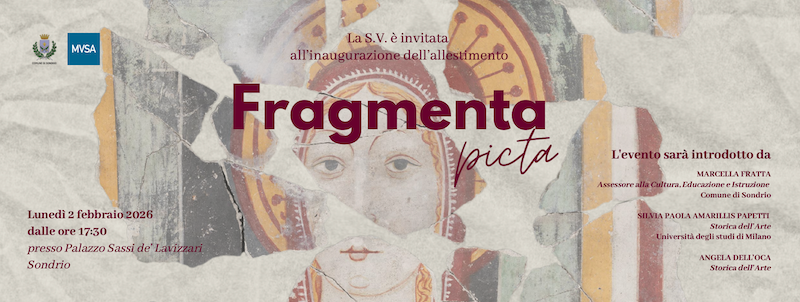
The "Fragmenta picta" project, dedicated to the study, recomposition, and enhancement of fragments of painted plaster from the church of Santa Maria della Sassella, will be presented on Monday, February 2, at 5:30 PM, at Palazzo Sassi de' Lavizzari, the headquarters of the Museo Valtellinese di Storia e Arte, in Sondrio.
The fragments were found in the late 1990s during archaeological excavations conducted under the floor of the church as part of the restoration work. The complex stratigraphic context, characterized by the overlap of at least five phases of use of the building, has yielded a significant core of fragments referable to the previous 15th-century church, buried simultaneously with the reconstruction of the current Renaissance building.
The systematic study of the materials and the careful recomposition work, carried out in 2013 by Silvia Paola Amarillis Papetti, Veronica Dell’Agostino, and the Mvsa Directorate, have allowed for the identification of about twenty homogeneous groups of fragments, attributable to a devotional wall decoration, articulated in images arranged along the lateral walls of the hall.
Among the recognized depictions are two Virgo lactans, a Trinitarian representation (Thronum Gratiae), images of the Virgin with Child, and figures of saints, sometimes identifiable thanks to the remains of painted tituli. A graffito date, 1462, found on a fragment pertaining to the Thronum Gratiae, provides an important terminus ante quem for the execution of this group of wall paintings, attributable to a workshop active in Lombardy, still linked to a late Gothic sensibility recognizable in other contexts in the Adda Valley.
For the first time, the fragments are now presented to the public within the Sacred Art section of the Museo Valtellinese di Storia e Arte, in a specially designed exhibition dedicated to the works from the church of Santa Maria della Sassella, a symbolic and deeply identity-forming place, always considered the most beloved church by the people of Sondrio.
The exhibition gives visibility to fragile and precious testimonies, allowing one to grasp, through the recomposed fragments, a little-known but highly interesting chapter of the artistic and devotional history of the area. The presentation of the Fragmenta picta project will provide an opportunity to delve into the phases of study, methodological choices, and the historical-artistic value of the fragments, placing them within the broader narrative of the church of Sassella and the heritage preserved by the Mvsa.