Ul scarpulii
Tue, 29/04/2025 - Curiosities
Tue, 29/04/2025 - Curiosities
Ul scarpulii
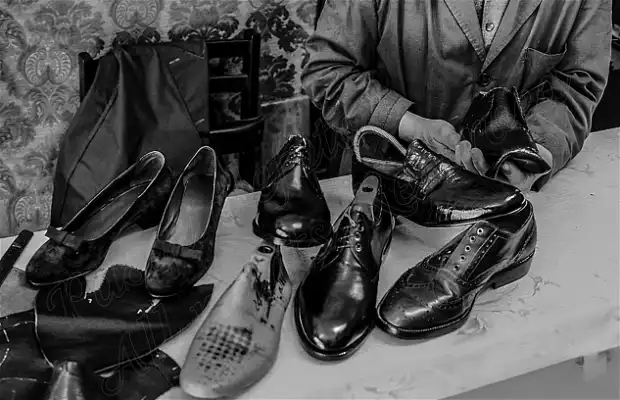
ANCIENT TRADES UL SCARPULII: THE SHOEMAKER
In winter, when agricultural activity was suspended, during the dead seasons, on rainy days, or when the need arose, and the countryside allowed it, some farmers abandoned their more traditional tools, sickle and hoe, and to supplement the meager earnings “from the land,” they would sit down to repair shoes.
“The trade” was learned by going “to the workshop” of an experienced shoemaker. The apprenticeship lasted two winters. During this time, “he earned” only experience: he was not paid.
New shoes were a rare luxury, as they owned only one pair, which were kept “alive” for a long time through resoling, repairs, and patches of every kind that involved the sole and the upper.
Lacking the economic means to change models whenever the season required, people were forced to turn to this “professional” for necessary repairs.
The farmer, in very rare cases, would buy “festive” shoes in the city shoemaker’s shop, lighter and finer compared to the heavy boots, while work shoes, or those worn on weekdays, were made by the village shoemaker.
Once a year, or when the family needed the cobbler’s intervention, they would “command” him to their home.
He would arrive early and sit next to the fireplace.
To protect his poor clothing, he wore an apron with a blue bib.
If he had to make a new pair of shoes, he would take precise measurements and write them down on cardboard from which he would cut out the uppers and soles.
The making of a pair of shoes, depending on whether it was for a woman, a man, or a child, took seven to eight hours of work.
In the shoes made for children, there was no distinction between right and left, so they were interchangeable from one foot to another: they were called the shoes for the right and left.
He was paid “per day” including food: the “menu” primarily consisted of polenta.
The tools were carefully guarded in a wooden box.
Tools: tripèe, lésna, puntiròl, tenaglia tanaaia, martello martél, pinza, wooden models of shoes, formi, sedula.
Material: cioot da tac, small nails ciudii, stèc dé lèegn, azzalini, zapèti, pèegula, spago spaach, curam, and la vachéta.
It was the head of the family himself who sourced leather from merchants in Sondrio.
Another typical footwear of the past, made not by the shoemaker but by the farmer himself, was the characteristic coosp.
In Val Malenco, they used pieces of fabric from broken hats or any other rag to make the slippers pédüf: they threw nothing away.
tripèe: an iron tool that shaped a large sole, a small one, and the heel.
With this tool, the leather was hammered to make it hard and thus more durable.
Those who didn’t have the tripèe would hit the leather on a rounded and well-smoothed rock found in the Adda.
lèsna: a flat curved iron tool, with a point and a wooden handle. It was used to make holes in the leather.
punteròl: a sharp iron awl with a wooden handle. It was used to make holes.
sedula: pig hair that served as a needle.
cioot da tac: nails with a square head to be placed in the heel.
stèc dé lèegn: wooden nails to be alternated with iron ones, to lighten the shoe.
azzalini: nails with a rounded head to be placed under the front half of the sole.
zapèti: bent hook nails to be fixed on the outer edge.
They reinforced the sole, but made it much heavier.
pèegula: pitch, a substance obtained from wood tar.
Before use, it was softened with heat.
It served a dual purpose: to bind the sèedula to the string and to lubricate the latter to make it easier to penetrate the holes.
curam: leather obtained from tanning the thicker part of cowhide.
vachéta: the softer part of cowhide.
coosp: They were obtained by “recycling” an old shoe with a sole so worn out that it could no longer be “recovered.”
In its place, they would put a kind of wooden clog quite high where they would mount, with suitable nails, an old upper.
A kind contribution from Mariella of UILDM Sondrio: memories collected from her parents