📍 Where it is located
The Church of Sant’Ignazio di Loyola overlooks Piazza Libero della Briotta, better known in the village as Piazza dei Frati, in the heart of Ponte in Valtellina. It is connected to the building that once housed the College of the Jesuits and which today houses the Municipal Library, the “Maurizio Quadrio” Middle School, and the Ethnographic Museum.
🕰 A bit of history
The construction of the church began in 1639, during a period of strong religious and cultural ferment related to the presence of the Jesuits in Valtellina. As early as 1642, the feast of Sant’Ignazio was celebrated there, but the decorative apparatus was only completed by the mid-eighteenth century, also thanks to the intervention of Valtellinese artists like Cesare Ligari.
🏛 Architecture and interiors
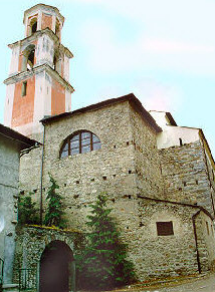
The church, in Jesuit style, has a plastered gabled façade, with pilasters at the corners, a green stone portal with a broken tympanum, a semicircular niche, and a central Serlian window. The square-based bell tower ends with an octagonal lantern, clearly visible from the entire square.
Inside we find:
- A single nave with two side chapels (attributed to G.B. Muttoni)
- Frescoed vaults and walls decorated with floral motifs, fake marbles, and Corinthian capitals
- A large presbytery with a marble balustrade, separating the liturgical space from the nave
- Wooden choir tribune, above the entrance, flanked by small ornate tribunes
- Four carved confessionals, decorated with little angels and caryatids
🎨 A decorative cycle entirely dedicated to Sant’Ignazio
The heart of the church is its iconographic cycle dedicated to Sant’Ignazio di Loyola, founder of the Jesuits:
- On the vault of the nave, Cesare Ligari frescoed in 1749 an image of the Saint radiating light onto the world.
- On the vault of the presbytery, the apotheosis of Sant’Ignazio is depicted.
- On either side of the main altar, two canvases by Giovanni Parravicini depict key episodes of his life.
- In the left side chapel, there are frescoes depicting scenes from the life of Saint Francis Xavier, one of Sant’Ignazio's most famous disciples.
📚 The link with the College of the Jesuits
Next to the church stood the ancient convent of the Jesuits, now converted into a school and cultural center. Here you can find:
- The “Maurizio Quadrio” middle school
- The Municipal Library
- The Ethnographic Museum of Ponte
A perfect example of how a religious complex has been integrated into the social and cultural life of the village while keeping its historical memory alive.
🧭 How to get there
- 🚗 By car: parking available in the center of Ponte in Valtellina, easily accessible from the SS38.
- 🚶 On foot: the church is located right in the historical center, ideal to reach while strolling through the village streets.
- 🚌 By bus: Sondrio–Tirano line, stop Ponte in Valtellina.
ℹ️ Useful info
- Address: Piazza Libero della Briotta – Ponte in Valtellina (SO)
- Opening: usually open for celebrations and guided tours
- Contacts: check the Municipality's website for bookings and updated hours
💬 Why visit it
The Church of Sant’Ignazio is not just a place of worship, but a fundamental stop to understand the cultural, educational, and religious history of Ponte in Valtellina. The art of Cesare Ligari and the Jesuit architecture make it one of the most significant churches in Valtellina.