The Stelvio Pass
Tue, 29/04/2025 - Curiosities
Tue, 29/04/2025 - Curiosities
The Stelvio Pass
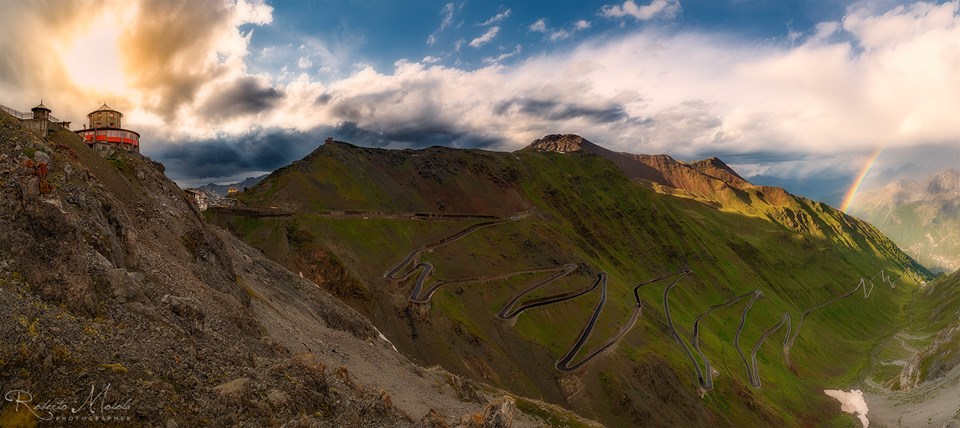
The Stelvio Pass (2758 m above sea level) is the highest motor pass in Italy, featuring a total of 48 hairpin turns on the South Tyrolean side and 36 on the Lombard side.
In the early 1800s, Emperor Franz I of Austria wanted a new road that could directly connect the Venosta Valley to Milan, then an Austrian territory, via Valtellina.
The task was entrusted to the chief engineer of the Province of Sondrio, Carlo Donegani (1775-1845), an expert in high mountain road engineering and already the designer of the Spluga Pass.
Work began in 1822 and employed a large number of workers, engineers, and geologists. After just three years, in 1825, the work was completed and inaugurated in the presence of a satisfied Emperor Ferdinand. The project cost approximately 2,901,000 florins. For Donegani, it was a shower of honors.
Near the pass, on the South Tyrolean side (then Austrian), the Austro-Hungarian Empire built three fortifications: Forte Gomagoi, Forte Klein Boden, and Forte Weisser Knott, which were part of the Gomagoi Barrier. Right at the pass, there are the remains of the Goldsee fortification.
Until 1915, the pass was traversed year-round by a stagecoach service thanks to the efficient work of snow plow operators throughout the entire winter. With the onset of World War I, it became the site of fierce clashes between the Austrian infantry and the Italian troops, as the pass is right on the Italy-Austria border.
After the victory on November 4, both sides became Italian, and the pass lost its original significance as a connection between Vienna and Milan, leading to the decision to close it for the winter.
Since 2014, a toll has been required to access the pass from the South Tyrolean side.
Source: wikipedia
In 1953, Fausto Coppi was the first to traverse this stretch of road that took his name: Cima Coppi. For the first time in the history of the Giro d'Italia in 2014, Passo Gavia and Passo dello Stelvio were included in the same stage.