Valtellina is winning over theatres around the world
Tue, 03/11/2026 - blog
Tue, 03/11/2026 - blog
Valtellina is winning over theatres around the world
...and maybe we don’t talk about it enough
From Valtellina stages to international recognition: Maurizio Zucchi, Pietro De Nova and Benedetta Carrara show that home-grown talent can go far too—especially in independent theatre.
I’ll be honest: this time I might be a little biased. But only a little.
Because Maurizio Zucchi is my nephew, and Pietro De Nova—well, to me he’s almost the same. I know them, I follow what they do, I’ve seen all their theatre pieces, and I’ve watched the growth of a project where they put imagination, work, nerve and a good dose of stubbornness into everything.
But there’s one thing I want to make clear: when I like a show, I like it. And when it doesn’t convince me, the fact that I know who’s on stage doesn’t change my opinion.
And these two artists, in my view, have something special.
I’ve seen them perform, transform, invent situations with hardly any props, use their bodies, facial expressions, movement and music to tell stories that often don’t even need words.
Their theatre is made of very little—but that very little turns into a lot.
You don’t need expensive sets, special effects or big productions. Sometimes all it takes is repurposed objects, a bit of lighting, a sound at exactly the right moment—and, above all, two actors who can keep the audience glued to the stage.
Because Maurizio and Pietro aren’t just actors. They’re also directors, lighting and sound technicians, and inventors of solutions which, in their simplicity, become part of the show.
And pay attention: behind this apparent simplicity there’s an enormous amount of work. Physical comedy—the kind that makes people laugh even without saying a word—demands precision, timing, coordination and an expressive ability that you can’t just improvise.
I’ve seen them throw themselves into new challenges again and again, take on different stages, travel with very little and keep believing in the way they make theatre.
Today, with the company Il Milione, they’re collecting major acknowledgements.
And they’re not the only people from Valtellina doing it.
Cafè Western: three first prizes and four nominations
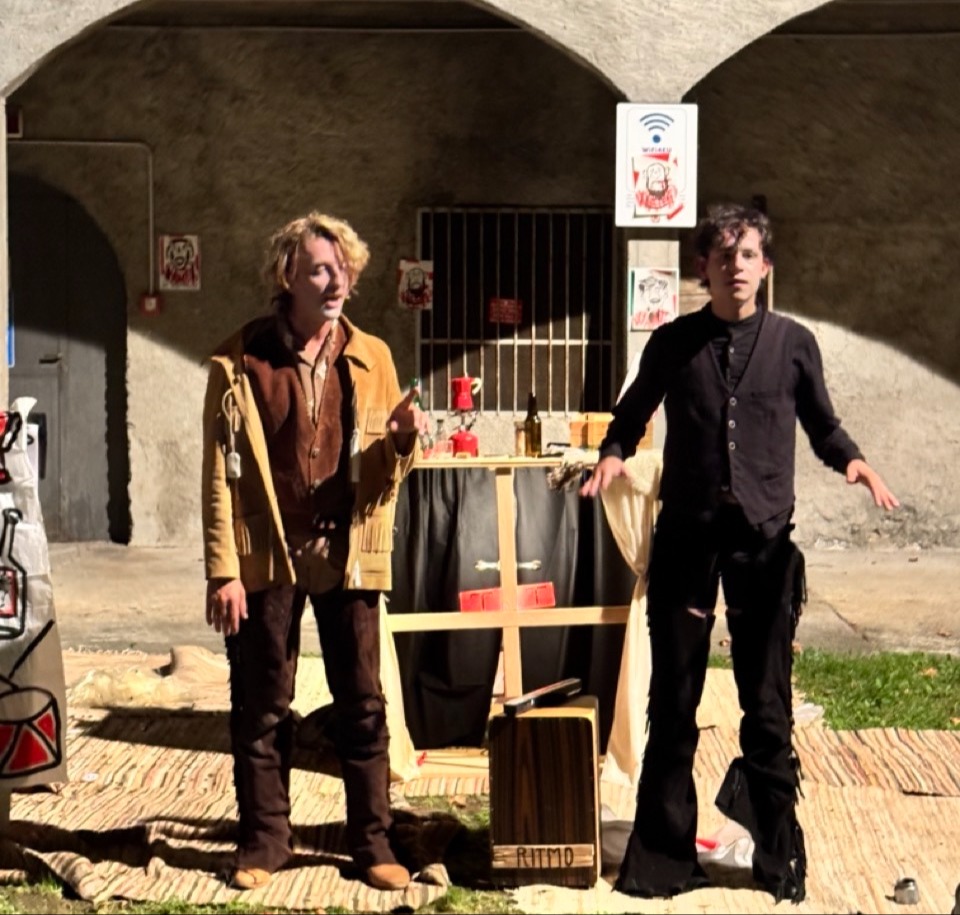
Their show Cafè Western is a comic fairytale set in a very unlikely Wild West.
There’s an outlaw with a bounty of just one dollar hanging over his head. And there’s a delivery lad who, because of a mix-up, ends up acting as the sheriff.
From there, it all kicks off with a chain of absurd situations, gags, chases and misunderstandings that take the mickey out of every cliché from Western films.
There’s very little dialogue. The story is told mainly through bodies, looks, gestures and comedic timing.
And that’s exactly what makes the show understandable even to people who don’t speak Italian.
In the Fringe Italia Off 2026 circuit, Cafè Western won three first prizes:
- First prize Denver Fringe, at the Catania Off Fringe Festival 2026.
- First prize Mumbai Fringe, at the Catania Off Fringe Festival 2026.
- First prize from the Staff of Fringe Italia Off 2026.
On top of that, it received four nominations: Il Respiro del Pubblico Festival and Dundee Fringe at the Milano Off Fringe Festival, Hollywood Fringe at Fringe Italia Off and Praga Fringe at the Catania Off Fringe Festival.
That’s seven acknowledgements in total—prizes and nominations combined—which open up new perspectives and the chance to bring the show to other international stages too.
And to think it all starts from the creativity of two actors who chose to tell stories using mostly themselves, their experience and a few stage props.
Benedetta Carrara wins in Las Vegas with Chiamatemi Franz
But the good news for Valtellina theatre doesn’t end there.
Benedetta Carrara, with her show Chiamatemi Franz, has also landed an important international award: the Fallout Fringe International Artist Award, awarded by the Fallout Fringe in Las Vegas.
And once again, we’re talking about a production that’s entirely rooted in Valtellina.
Benedetta worked alongside Massimiliano Greco, Alice Sciarmella, Michele Mazzoleni and Antonio Muraca.
The show tells a true story: that of Francesca Scanagatta, a woman who in 1794 decided to take her brother’s place in order to enter the Austrian military academy.
She adopted a male identity as Franz and managed to become an army officer.
An astonishing tale—especially when you think about the time it takes place—and one that uses theatre to tackle themes such as individual freedom, identity and the courage to challenge social conventions.
Chiamatemi Franz also received the patronage of the Comune di Talamona, the hometown of Francesca Scanagatta’s husband.
It’s great to think that a story from the past—brought back to life by artists from Valtellina—has managed to earn recognition all the way in Las Vegas.
So what exactly are Fringe Festivals?
Maybe someone is wondering what these festivals with international-sounding names are all about.
Fringes are festivals dedicated mainly to independent theatre and to artistic forms that experiment with languages different from the more traditional ones.
Their story begins in 1947 in Edinburgh, Scotland, when eight companies that hadn’t been invited to the official festival decided to perform anyway—putting on shows in alternative spaces.
That initiative gave rise to a movement which went on to spread around the world.
Today, Fringes are important opportunities to meet other artists, compare ideas with different audiences and get noticed by promoters and artistic directors.
For independent companies like Il Milione and for productions such as Chiamatemi Franz, taking part in these circuits means having the chance to grow and find new opportunities.
And winning prizes and getting nominations means receiving recognition for your work.
Two shows born in Valtellina that look far ahead
There’s also one particular thing I like to point out.
Cafè Western and Chiamatemi Franz both debuted at the Auditorium of Castionetto di Chiuro.
They started from right here—from our valley.
And today, they’re making people talk about them in national and international theatre circles.
Between the two productions, there’s more than just geographic closeness, too. There’s collaboration built on mutual support: promoting the shows, sharing experience and helping out with the organisation.
In a world of performance, where competition is often fierce, that feels particularly important to me.
Valtellina isn’t just sport, mountains and good food
And that brings me to the reason I wanted to tell this story.
When an athlete from Valtellina wins a race, rightly, we talk about it. When one of our local food products wins an award, we’re proud. When Valtellina is chosen for a major sporting event, the news makes the rounds in the papers.
But what happens when it’s our artists who get major recognition?
How much space do we actually give to culture, theatre, music and the people who choose to live by creativity?
Because this is also one way to make Valtellina known.
And it’s not an easy road.
Making independent theatre often means looking after everything, from writing to production, from rehearsals to travel, from finding venues to promotion.
It means investing time, energy and resources without the certainty that it will all pay off.
And yet there are people who keep doing it, because they genuinely believe in their work.
I’m happy when I see people from Valtellina managing to take their talent beyond our borders.
I’m even happier when I learn about the journey that got them there—the difficulties, the working hours and the determination needed not to give up.
Maurizio, Pietro and Benedetta, together with the people who work with them, are showing us that even from a small valley, theatrical projects can be created that are appreciated far away.
I don’t know which stages are waiting for them next. I hope there are lots.
But one thing I know: these stories deserve to be told—not because the protagonists are from Valtellina, but because they’re genuinely good at what they do.
And when skill meets the courage to give it a go, it’s only right to give it space.
That, too, is Valtellina.
And we should be talking about it much more often.