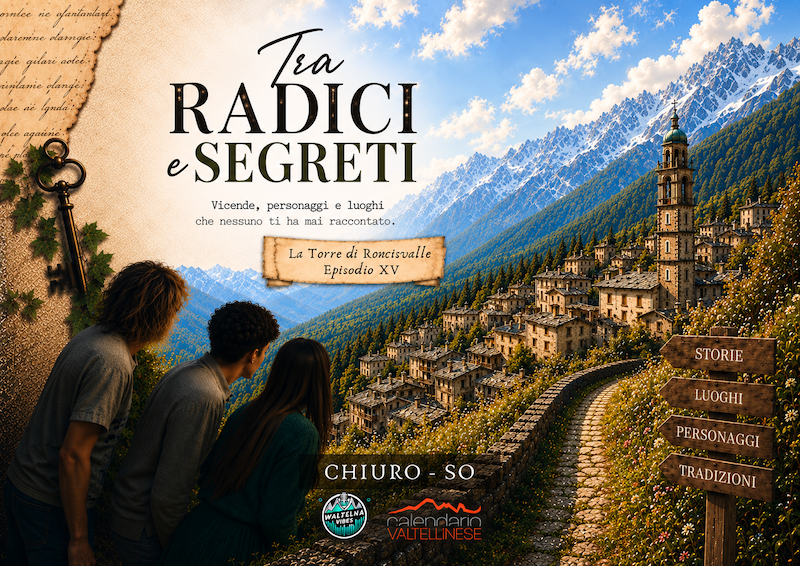
What does the Tower of Castionetto have to do with Orlando Furioso? The medieval tower of Castionetto in Chiuro, linked to the Quadrio family, is also known as the Tower of Roncisvalle—a name that echoes the place in Navarre connected with Orlando. In 1460, the area below the tower appears in a document as “Ronzivallem”: the name refers to the land, not the building. The link with Ariosto is cultural: today the tower houses a Hippogriff, a sculpture from 2016, as part of the Orlando Furioso in Valtellina project. None of the sources consulted links Ariosto or Orlando to the tower’s history: the connection comes from a name.
We went to Castionetto di Chiuro, standing in front of a tower that once protected the valley and now keeps a lost piece of wisdom. That wisdom is Orlando’s. How it ended up there, and how the day ends, you’ll find out below.
Where is the Tower of Castionetto and what does it look like?
The tower stands in Castionetto, a hamlet of Chiuro, half-way up the hillside on the Retic side, overlooking the Valfontana from a height of its own, at about 689 metres above sea level. You can reach it with a short detour from the panoramic road Sondrio–Teglio.
It has a roughly square footprint, about 11 metres per side, stands around 15 metres tall, and its walls are over 2.5 metres thick at the base. It has lost its battlements and part of the top. The original gateway is more than 3 metres above the ground: two arrow slits above the door suggest a drawbridge, but that’s a hypothesis drawn from construction details. A vaulted stone staircase connects the floors.
Who built the Tower of Castionetto?
Tradition attributes it to Stefano Quadrio, a military captain who led Chiuro from the late 1300s to the first half of the 1400s. There are no documents about the construction date, and scholars place it between the 12th and the 15th century. For that reason, we just say “a medieval tower linked to the Quadrio family”.
According to local records, in 1487 it served as a stronghold against the attempted invasion by the Grisons, under the command of Zenone Groppello. In 1622 it belonged to the School of the Rosary, and later to the School of the SS. Sacramento. In 1885 it was expropriated and became municipal property. Then it fell into neglect. Restoration, funded through the Legge Valtellina, reopened it to the public in May 2003.
Why is it called the Tower of Roncisvalle?
The oldest name is the name of the place. In a 1460 document, the sale of a property is described as being “ad Ronzivallem”—meaning below the tower, where there were terraced vineyards. The document confirms the location, not the building’s name.
There are two explanations for the meaning of that name, reported by local sources. The philologist Cesare Segre traces it back to “roscida valle”, meaning “humid valley”, and to “ronco”, from runcare: to break up and clear land in order to plant vines. Neither of the two has been proven.
Then there’s the coincidence. Roncisvalle is also the place in Navarre where, in legend, Orlando dies. That’s where the modern idea of calling the tower the “Tower of Roncisvalle” comes from. The connection is cultural and does not prove the etymology. The date when the name was first used for the tower is still to be confirmed.
What does Orlando Furioso have to do with it?
Orlando Furioso is the poem by Ludovico Ariosto. Orlando, a knight of Charlemagne, goes mad with love. Another knight, Astolfo, goes to the Moon to retrieve Orlando’s reason, and finds it inside a vial. The Hippogriff—half eagle and half horse—is one of the creatures in the poem.
At the upper level of the tower there’s a sculpture of the Hippogriff, the work of artist Raffaele Menonna, known as MERA. The plaque is dated 2016, and the project website links it to initiatives marking the five hundredth anniversary of the first edition of the poem, published in 1516. The reel also shows the vials of Orlando’s wisdom.
The tower is part of Orlando Furioso in Valtellina, a cultural route that includes three other places: Palazzo Valenti in Talamona, Castello Masegra in Sondrio, and Palazzo Besta in Teglio. The project site is signed by the Bradamante cultural association in Teglio.
So did Ariosto pass through here? No source we consulted says so. The poem reached the tower through a name and a display, and the story of the place remains that of a fortification.
Ristorante Da Silvio Fancoli: Valtellinese cooking in Castionetto
After the visit, we sat down to eat at Silvio’s in Castionetto. Ristorante Da Silvio Fancoli is a partner in this episode. It’s a long-established restaurant in the hamlet, run as a family business, that’s been in Valtellina for many years. Today it’s run by two young brothers, Daniele and Renato.
The cooking is traditional Valtellinese, rooted in local produce, with a careful selection of ingredients and a seasonal approach. You can enjoy great sciatt, pizzoccheri and tarozz, homemade pasta, tagliatelle with game or mushrooms, game ragù, polenta and excellent meat, with local wines.
Along with the bar and the main dining room, there’s a room on the lower floor carved into the rocks. In the reel you can see the dining room and a plate of tagliolini with mushrooms. To book, the site asks you to call directly.
📍 Via Madonnina 2/4, Castionetto di Chiuro (SO)
📞 +39 0342 563006
🌐 ristorantedasilviofancoli.it
Facebook: Ristorante DA Silvio Fancoli