"You're a tananài": the legend behind the most common saying in Valtellina
If, in Valtellina, someone has ever called you a "tananài", you already know what it means: you’re an innocent, a fool, a silly person. What you probably don’t know is the story behind this word. A legend still passed down today in Villa di Tirano, and that starts from a true historical event: the plague of 1629.
1629: when the plague reached the valley
Everything begins with the Landsknechts—armies that, in 1629, came down into the valley from Val Bregaglia and Val San Giacomo, heading toward the Lecco area, Milan, and Mantua. Before continuing, they stopped long enough to leave something far worse than looting behind them: the plague. The same plague described by Manzoni in The Betrothed.
The disease also devastated the Tirano area, and many chose to flee to the mountains just to move away from the contagion.
Three women, a refuge, three loaves
This is where the legend, passed down in town, begins. Among those who left Villa di Tirano would have been Caterina, Lucia, and Giuseppina. They found shelter in a bait, a small baitello used to store food, in the locality of Bursée (Borserio). They decided to stay there until the end of the plague.
To figure out when it would be safe to go out, they devised a system of their own: every day, with the utmost caution, they placed three loaves on a low wall outside the refuge. As long as they found mold, it meant the air was still infected. This went on for a long time.
Then, the legend says, one day the bread was clean.
The return, and what they found
Joy didn’t last long. When they left the refuge, the three women would have realized that in the hamlet there was not a single living soul left. They returned to Villa di Tirano hoping for something different, but they found only signs of death. No living person.
There was only one thing left to do: head toward the upper valley, in search of someone who had survived.
The meeting at Sant'Antonio Morignone
Even further north, the situation didn’t seem any better. But at Sant'Antonio Morignone, the legend says, the three women would have come across a man with a decidedly unusual appearance: ugly, dirty, awkward in his movements in a way that was almost comical.
In normal times they wouldn’t have even given him a second look; maybe they would have even laughed. But after what they had been through, that man—someone who had survived death—represented something enormous for them: life that continued, the chance to start over.
They took him with them. Literally: they loaded him, one after another, onto a gerlo, so he wouldn’t get tired during the journey to Villa. They gave him a nickname, Tananài, and they took him as a husband, shared between the three of them.
From a nickname to a saying
From that union, the tradition goes on to say, children would have been born—boys and girls—who in turn grew up, married, and gave life to a new generation. That’s how, according to the legend, the Tirano area repopulated after the plague.
And that’s also how the saying that you can still hear today in many parts of Valtellina would have come about: "you’re a tananài".
We tell it too in video
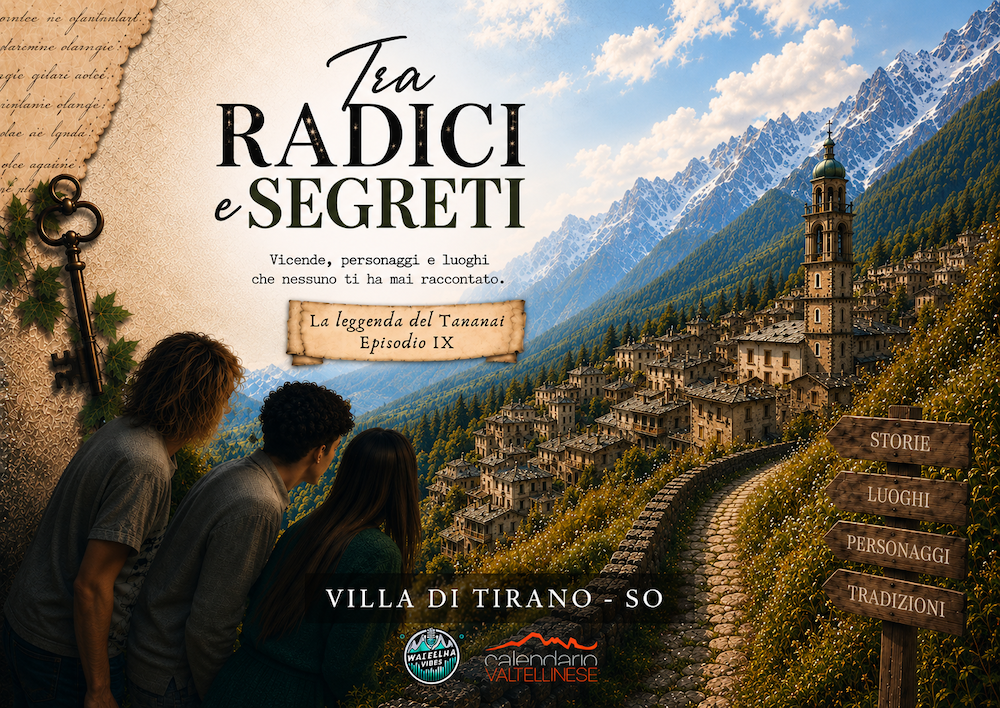
The story of Tananai is the focus of the ninth episode of Between Roots and Secrets, the video series that features the collaboration between Calendario Valtellinese and Waltella Vibes.
If you want to watch the reel again, you can find it on our YouTube profile